As AI reshapes work and talent becomes the defining competitive advantage, the Chief Human Resources Officer is emerging as one of the most influential voices in the boardroom.
For decades, business strategy revolved around capital, technology, and market expansion. Today, another force has moved to the centre of every boardroom conversation: people.
Artificial Intelligence is redefining jobs. Hybrid work has rewritten employee expectations. Skills are becoming obsolete faster than organisations can replace them. Leadership pipelines are under pressure, while talent shortages continue to challenge businesses across industries.
In this new reality, the organisations that outperform won't simply be those with better technology. They will be those that build stronger leadership, more agile cultures, and future-ready workforces.
That responsibility increasingly rests with the Chief Human Resources Officer.
The CHRO Has Entered the Boardroom
The role of the CHRO has undergone one of the most significant transformations in the modern enterprise.
Once viewed primarily as the custodian of talent acquisition, employee relations, and compliance, today's CHRO is expected to influence business strategy, shape organisational design, lead enterprise transformation, develop leadership pipelines, strengthen culture, and enable long-term business resilience.
As organisations embrace AI, automation, and new operating models, HR leaders are being asked questions that extend far beyond people management.
How should work be redesigned for an AI-enabled workforce? Which skills will define the next decade? How can organisations balance productivity with employee wellbeing? What kind of culture sustains innovation during continuous disruption?
These are no longer HR questions alone. They are business questions.
People Strategy Has Become Business Strategy
Technology may create competitive advantage, but people determine whether organisations can sustain it.
The modern CHRO sits at the intersection of business, leadership, technology, and culture. They are increasingly responsible for helping organisations navigate workforce transformation, organisational agility, succession planning, mergers, digital disruption, and leadership development while ensuring that talent strategies remain aligned with long-term business objectives.
Success in this role demands more than functional HR expertise. It requires business acumen, analytical thinking, financial understanding, organisational influence, and the ability to lead enterprise-wide change.
The next generation of CHROs will not simply manage talent. They will shape business outcomes.
Preparing HR Leaders for Enterprise Leadership
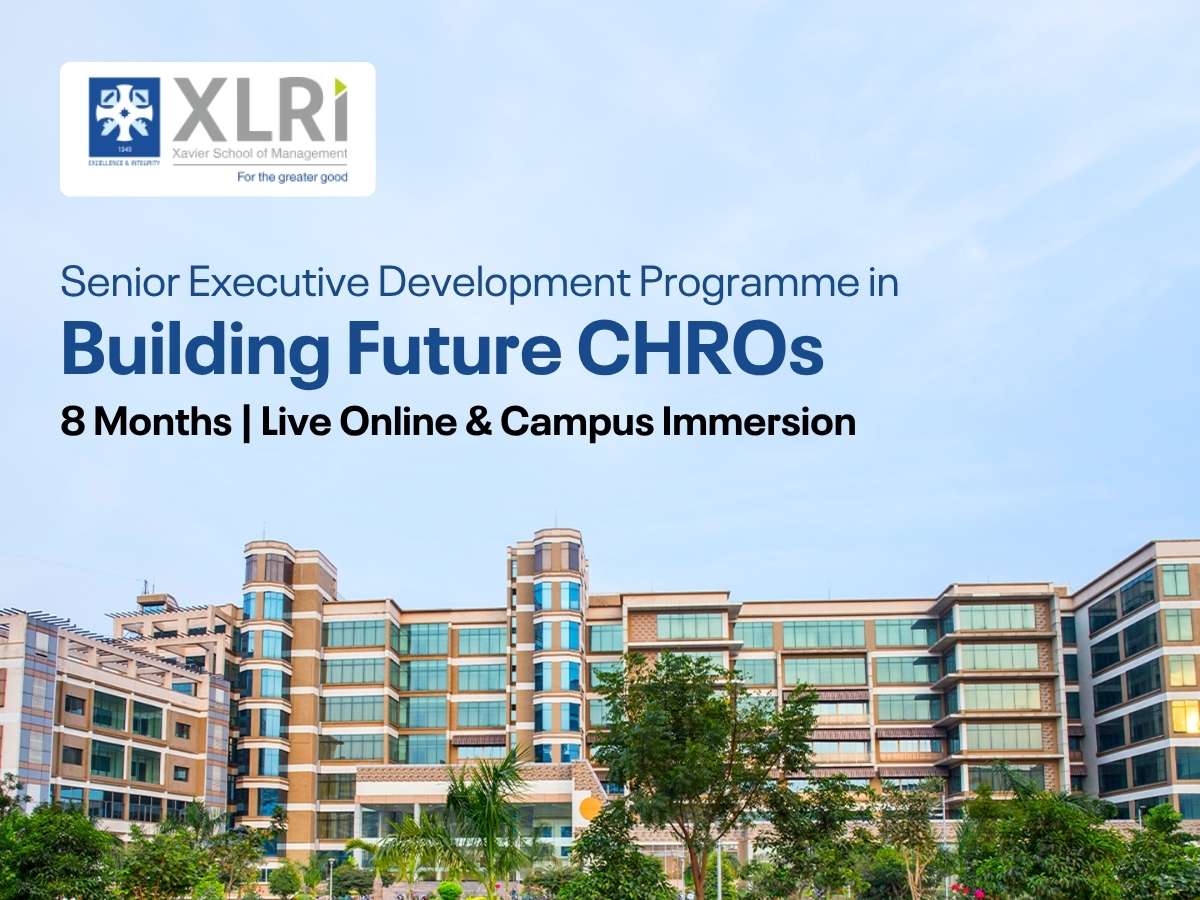
Recognising this evolution, XLRI Jamshedpur has introduced the Senior Executive Development Programme in Building Future CHROs, an eight-month executive programme designed for experienced HR leaders aspiring to take on broader strategic leadership responsibilities.
Designed for professionals with at least ten years of HR experience, the programme combines more than 100 hours of live online faculty-led learning with two campus immersions, real-world case studies, business simulations, cross-industry peer learning, and a capstone project focused on contemporary organisational challenges. Participants who successfully complete the programme also receive an XLRI certificate and become eligible to apply for Executive Education Alumni Status.
The programme curriculum reflects the changing expectations of the CHRO role, covering strategic HR leadership, workforce planning, organisational design, talent strategy, performance and rewards, leadership development, HR analytics, business finance, operations, change management, industrial relations, and enterprise decision-making. Rather than viewing HR as a standalone function, the programme equips participants to connect people strategy with business performance.
A Legacy That Has Shaped Generations of HR Leaders
Few institutions have influenced HR education in India as profoundly as XLRI.
With more than seven decades of excellence in management education and a longstanding reputation as one of the country's most respected institutions for human resource leadership, XLRI has consistently developed business leaders who have gone on to shape organisations across industries.
That legacy gives the programme relevance beyond the classroom. Participants become part of an institution recognised for combining academic rigour with practical leadership development, supported by experienced faculty, industry-focused learning, and a powerful executive network.
The Next Great Business Leader Can Come from HR
As organisations continue to navigate AI, workforce disruption, and changing business models, leadership itself is being redefined.
The future belongs to executives who can align talent with strategy, culture with transformation, and people with long-term business value.
In many organisations, that leader will not simply be the CEO.
It will be the CHRO.
Click here to know more about the programme.